Word of Mouth Marketing Offline: Get People Talking
Word of mouth marketing without fake reviews: what is legal, which real-world moments people retell, how to set up referrals and measure what the buzz brings.
7 min readFortuners Team
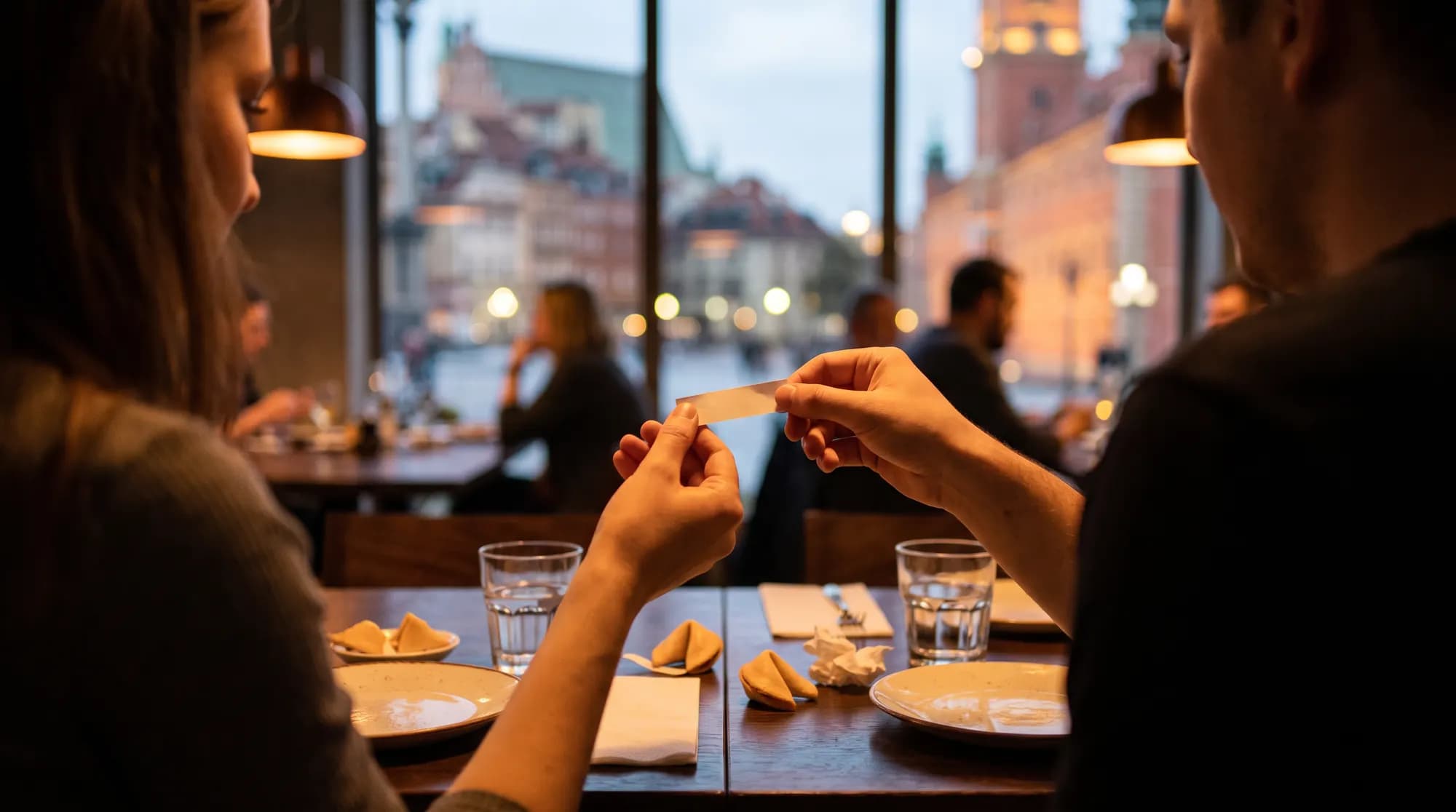
Word of mouth marketing means giving people a genuine reason to talk about your brand and making it easy for them to recommend you to friends. It is not an agency posting on forums or a batch of bought reviews. Those tactics deceive customers and break the law in the EU, the UK and the US. Real word of mouth is built on experiences customers retell on their own: over dinner, at work, in a neighbourhood chat group. This guide covers the legal limits, four triggers that start conversations, offline examples, a referral program template, ways to measure the results and a four-week plan.
What word of mouth marketing is (and what it isn't)
These terms are often used interchangeably, but each one leads to different actions.
| Term | What it means | Offline example |
|---|---|---|
| Organic word of mouth | Natural conversations about a brand that happen without your involvement | A client recommends her hairdresser to a colleague |
| Buzz marketing | A one-off stunt designed to spark a wave of conversation in a short time | An unusual venue opening the whole street talks about |
| Referral marketing | Systematically encouraging customers to recommend you, usually with a reward | A "bring a friend" card at a yoga studio |
| Word of mouth marketing | The umbrella term for everything that triggers and amplifies conversations about a brand | All of the above, planned and measured |
If you work with Polish agencies, you will hear the term marketing szeptany, literally "whisper marketing". Before hiring an agency under that label, check that it means genuine recommendations, not posts from fake accounts.
Word of mouth marketing is not:
- posting comments on forums and in groups from fake accounts,
- buying reviews on Google or on online marketplaces,
- paying creators for "honest recommendations" without disclosing the partnership,
- asking employees and family members to leave ratings.
Besides breaking the law and platform rules, these tactics undermine what word of mouth depends on: trust in recommendations.
The legal line: fake reviews, hidden ads and disclosure
In Poland the main framework is the Act on Counteracting Unfair Market Practices, which implements EU rules. It includes a blacklist of practices treated as unfair in all circumstances. For word of mouth marketing, the most relevant are:
- Hidden advertising, meaning content that looks independent even though a business paid for it, without this being clear from the message.
- Posing as a consumer, meaning falsely suggesting that a business is not acting for purposes related to its trade.
- Fake reviews. Since 1 January 2023, when Poland implemented the EU Omnibus Directive, the rules explicitly cover posting or commissioning false consumer reviews or recommendations and distorting reviews, for example by publishing only the positive ones.
The Polish consumer protection authority, UOKiK, can impose fines for these practices and has already done so in fake review cases, as described in its press release Fake opinions? Stop! (opens in a new tab). When working with creators, the reference point in Poland is UOKiK's recommendations on labelling advertising content by influencers: the label must be visible straight away, unambiguous and in Polish, such as "reklama" (advertisement) or "współpraca" (partnership).
Elsewhere the direction is the same. In the UK, bans on fake reviews and concealed incentivised reviews under the Digital Markets, Competition and Consumers Act 2024 have applied since 6 April 2025. In the US, the Federal Trade Commission's rule banning fake reviews and testimonials (opens in a new tab) took effect in October 2024. On top of the law come platform rules: Google, for example, prohibits offering incentives in exchange for reviews and selectively asking only for positive ones.
A simple working rule: reward referrals that end in a purchase, never the content of a review. And never speak on a customer's behalf.
Why people talk about brands: 4 triggers
People do not talk about brands because a brand wants them to. They talk because something gives them an excuse to. Test every idea against four questions.
- Surprise. Does the customer get something they did not expect? Standard service, even very good service, rarely becomes a topic of conversation. A handwritten note in a parcel or a small gift for no particular reason does.
- A one-sentence story. Can the customer sum it up at the dinner table? "At this pottery studio you go home with a mug fired with your own fingerprint on it" is a sentence someone will repeat. "They have a nice vibe" tells nobody anything.
- Something to show. Is there an object, a photo or a gesture people can pass around? A physical item starts the conversation for you: "Look what I got."
- A benefit for a friend. Can the person recommending you pass something on? A first-visit code for a friend turns a nice story into an invitation.
An idea that ticks three of the four boxes has a real chance of spreading. An idea that ticks none will stay an ad nobody mentions.
Offline word of mouth marketing examples: moments people retell
Online, a conversation about your brand competes with a thousand other posts. Offline, it happens between people who know and trust each other. Here are moments a local brand can design on purpose.
| Moment | What people say | Example |
|---|---|---|
| The first visit | "By my second class the trainer remembered why I'd signed up" | A fitness studio notes each newcomer's goal and comes back to it in later sessions |
| The end of a service | "When I picked it up, there was something extra I didn't expect" | A bike workshop returns the bike with a clip-on light and a card signed by the mechanic |
| Packaging | "Even the bag was thoughtful" | A bookshop slips in a bookmark with the bookseller's next recommendation |
| A small-group event | "There were only twelve of us and the owner showed us around himself" | A coffee roastery hosts a tasting for regulars and their guests |
| An offer in someone else's venue | "I found an offer from the studio next to my office inside a fortune cookie" | A brand puts its offer inside fortune cookies served at a café |
When a brand's message appears somewhere unexpected and in a pleasant form, people are happy to show it off. That mechanism is the basis of ambient marketing. Here is what such a slip could look like (an illustration, not a real campaign):
This month you'll make something with your own hands.
The slip hits all four triggers: it surprises, it can be summed up in one sentence, it can be shown to the person across the table and the offer is designed for two. This is how Fortuners works: fortune cookies carrying a brand's offer are served with the bill to guests of hand-picked cafés and restaurants in Warsaw, and a QR code on the slip lets the brand count every scan and redeemed code. If you are wondering where the custom of serving fortune cookies came from, read our piece on fortune cookie origin.
How to set up a referral program for a local business
A referral program is the simplest way to turn conversations into visits. A well-designed one has five parts.
1. Who refers. Existing customers, ideally right after a good experience. Hand over the card or code when the customer is happy, for example after they see the first results, not at sign-up.
2. What the friend gets. A first-visit perk that lowers the barrier to trying you: a free first class, an extra service with the first purchase, a trial week.
3. What the referrer gets. A reward once the friend has actually bought something. Ideally in your own products or services rather than cash: it costs you less and brings the referrer back.
4. How you recognise a referral. A code assigned to the referrer, for example a first name plus a few characters (ANNA-7K2), a numbered card or a dedicated link. Avoid typing mistakes by leaving out characters that are easy to confuse, such as 0 and O or 1 and I.
5. The rules. Terms and conditions covering who can take part, how many times someone can refer, how long a code is valid and when the reward is due. Do not ask referrers for their friends' contact details. Let the friend come to you with the code. That is simpler from a GDPR point of view, too.
Sample copy for a referral card:
Know someone who'd love it here? Give them this card. On their first visit they'll get [perk]. Once they've used it, you'll receive [reward]. Code: ANNA-7K2 · valid until [date] · terms at [website address].
Before you launch a referral program
- The friend's perk is attractive and you know what it costs.
- The referrer's reward is only due after the friend makes a purchase.
- Codes are unique, easy to type and assigned to individual people.
- Your team knows where to record a code and how to hand out a reward.
- The terms are published online and have been checked for legal compliance.
- You know your baseline: the number of new customers per month before launch.
How to measure word of mouth
You will never measure word of mouth completely, because most conversations happen where nobody is counting. A few indicators, taken together, will still show the direction.
- Referral codes. The number of codes redeemed, the number of active referrers and the share of new customers who came through a referral.
- A question at checkout. "How did you hear about us?" with a fixed list of answers: from a friend, Google, social media, walked past, other. Record the answers in your POS system or on a sheet by the till.
- Searches for your brand name. If people are talking about you, more of them type your name into Google. You can check this in Google Search Console (queries containing your name) and in your Google Business Profile performance stats.
- Scans of dedicated QR codes. If the item customers pass on has its own QR code, every scan is a trace of a recommendation.
Always record your starting values, ideally from the four weeks before launch. Without a baseline you cannot tell the effect of the program from seasonal swings.
Illustrative example (made-up figures): in one month, 40 new customers used referral codes. The friend's perk costs you PLN 25, the referrer's reward PLN 30, and printing the cards PLN 200. Your cost per referred customer is (40 × PLN 55 + PLN 200) ÷ 40 = PLN 60. Compare that with the cost of a customer from your other channels and with how much a customer spends with you in a year. Our guide on how to calculate customer acquisition cost shows how to make that comparison.
A 4-week word of mouth marketing plan
The plan below suits a local service business: a studio, salon, school or workshop. Adapt it to your industry. For the wider context of marketing in your neighbourhood, see our local marketing strategy guide.
| Week | Actions | What you measure |
|---|---|---|
| 1 | Pick one moment to design (see the table above). Prepare referral cards and codes, the terms and the "how did you hear about us?" question. | Baseline: new customers, answers to the question, brand name searches |
| 2 | Launch the moment and the referral program. Brief the team on when to hand out cards and how to record codes. | Cards handed out, first codes redeemed |
| 3 | Something to show outside your own premises: for example an offer inside fortune cookies at cafés nearby, or a joint campaign with a neighbouring business. | QR code scans, codes redeemed, "from a friend" answers |
| 4 | Review: cost per referred customer, most active referrers, feedback from the team. Decide what becomes permanent. | Customer acquisition cost, share of referrals among new customers |
Do not expect an avalanche after four weeks. Expect answers to three questions: do people actually pass the cards on, do their friends use them, and what does a customer acquired this way cost you? That is enough to decide whether to grow the program or pick a different moment for people to talk about.
Frequently asked questions
Is word of mouth marketing legal?
Yes, as long as it is built on genuine customer experiences and transparent rules. What is illegal are its dishonest forms: posing as a customer, posting or commissioning fake reviews, and hidden advertising dressed up as a personal recommendation. If you run a referral program or work with creators, have the details checked by a lawyer.
How much does word of mouth marketing cost?
There is no standard rate, because it is a set of activities rather than a service with a price list. Offline, you mainly pay for referral rewards, materials such as cards, packaging or small gifts, and your team's time. The most useful number is the cost of acquiring one referred customer, compared with your other channels.
What is the difference between word of mouth and viral marketing?
Viral marketing usually relies on a piece of content, such as a video, that spreads online by itself. Word of mouth is broader: it covers every conversation about a brand, including over dinner, at work or among neighbours. Offline, you do not count shares. You count recommendations that end in a visit or a purchase.
Can I reward customers for referrals?
Yes. Referral programs with rewards are a common and legitimate practice when the rules are clear and written down in terms and conditions. Reward a referral that ends in a purchase, never the content of a review. If a referrer posts about you online in exchange for a reward, the post should be clearly marked as advertising or a paid partnership.