Ambient Marketing: A Guide with Examples and Measurement
Ambient marketing from mechanism to execution: how it differs from outdoor and guerrilla, formats for local brands, permissions, measurement and a checklist.
9 min readFortuners Team

Ambient marketing is a brand message built into the audience's surroundings: an object, a place or a situation people are already dealing with. It is not another billboard; it becomes part of the moment. Ambient advertising works when three things meet: context (the message fits the place and the moment), surprise (nobody expected an ad right there) and proximity (the message is within arm's reach). This guide covers definitions, the main types with examples, formats a local brand can actually use, a step-by-step planning process, permissions in Poland, how to measure results and a project checklist.
What is ambient marketing? Definition and how it differs from outdoor
"Ambient" means surrounding. In advertising, ambient media are messages that do not sit in an obvious, dedicated ad space. Instead, they use elements of the environment: stairs, handrails, a coffee cup, a bill folder, a takeaway bag. You will also see the same area described as unconventional advertising or non-traditional media.
The main difference from classic outdoor advertising is the relationship with the location. A billboard stands next to a road and could stand next to any other road. Good ambient advertising only makes sense where it was placed, because it uses what people are doing, seeing or holding at that moment.
The related terms often get mixed up, so here is how they compare:
| Term | What it is | Typical places | Relationship with the surroundings |
|---|---|---|---|
| Outdoor (OOH) | Standard outdoor media in fixed formats | Billboards, city light panels, building wraps | The medium is independent of the place |
| Ambient marketing | A message built into an object, place or situation | Cups, bill folders, stairs, mirrors, packaging, venues | The message uses its surroundings |
| Guerrilla marketing | Low-budget tactics built on surprise and buzz | Streets, events, social media | Often a one-off stunt, sometimes close to the legal line |
| Experiential marketing | A live brand experience people take part in | Pop-ups, events, brand zones | The experience itself is the message |
| BTL (below the line) | Activity outside mass media, with direct contact | Sampling, events, point of sale, loyalty schemes | The umbrella that ambient usually falls under |
| Contextual advertising | Matching the ad to the person's content or situation | Online: page content; offline: place and time | Shares ambient's core idea: hit the context |
The boundaries are fluid. The same campaign may be called ambient in one article and guerrilla in another, and end up in the BTL line of the budget. In practice, a better question than the label is this: does the message use its surroundings, or does it simply stand in them?
An example that often appears in writing about ambient: in 2009, Volkswagen's The Fun Theory initiative turned the stairs at Odenplan station in Stockholm into working piano keys. The stairs themselves became the medium, and walking up them became an experience. It illustrates the principle well, even though a local brand usually works on a very different scale.
Why ambient advertising works: context, surprise, proximity
Ambient advertising does not work by definition. It works when it meets three conditions at once. Take one away and you get either a gimmick or an ordinary ad in an unusual spot.
Context: the right place and moment
The message should connect with what people are doing or feeling at that moment. A dance school's offer printed on a coaster in a karaoke bar has context. The same offer at a petrol station does not.
Context does two jobs. First, it filters the audience: the people in a matcha café are not the people in a kebab shop at 3 a.m. Second, it sets the mood: a guest who has just finished a good dinner is in a different state of mind from someone waiting for a late tram.
Surprise: breaking the pattern
People quickly stop noticing the places where ads usually appear. Ambient gets past that filter because it shows up where nobody is looking out for advertising. The surprise does not have to be spectacular. It is enough that an object does something unexpected or says something that fits the moment.
Be careful with surprise that confuses. If, after a few seconds, people still do not know who is talking to them and what they are being asked to do, the idea may look clever but it does not work as advertising.
Proximity: a message within arm's reach
The strongest ambient formats are the ones people physically touch: they hold the cup, open the packaging, pick up the slip of paper. Proximity also means longer contact than a glance on the move, and often a single message with no competing ad next to it.
Advantages and limitations of ambient marketing
Ambient is not the right answer for every brief. Before you commit, weigh what the format does well against what it makes harder.
| Advantages | Limitations |
|---|---|
| It feels less intrusive, because it fits the place and the moment | Reach per location is limited, so scale comes from many locations |
| You choose the audience by choosing the place | Every location needs a permission, a delivery plan and someone who looks after it |
| Physical contact means longer attention than a passing glance | A clever idea can confuse people if the brand and the next step are unclear |
| A good execution invites photos and conversation | A badly placed stunt can look like litter or vandalism and hurt the brand |
| It is easy to measure when a code is built into the placement | Without codes planned in advance, results are mostly anecdotal |
Types of ambient advertising: public space, objects, venues, packaging
Ambient formats can be grouped by what they use. The table below sorts the most common types, with the scale and risks involved.
| Group | Example formats | Strength | Watch out for | Accessible to a local brand |
|---|---|---|---|---|
| Public space | Murals, bus-stop installations, pavement graphics, projections on buildings | High visibility, photo potential | Permits, local rules, production cost, safety | Low to medium |
| Transport and infrastructure | Handles on public transport, stairs, lifts, bike racks | Repeated contact with the same people | Contracts with the operator or site manager, media standards | Medium |
| Everyday objects | Cups, cup sleeves, rental umbrellas, tote bags | Physical contact, longer exposure | Unit cost, production quality | High |
| Restaurants, cafés and service venues | Coasters, bill folders, fortune cookies, mirrors, counter displays | Precise audience selection through the venue's profile | Owner's consent, fit with guests, logistics | High |
| Packaging and deliveries | Stickers on boxes, inserts in takeaway bags, prints on a partner's packaging | Reaches the person's home or office | Partnership with the packaging owner, print deadlines | High |
| Events and occasions | Festival zones, elements of fun runs, seasonal activations | Strong emotion, natural context | Short window, dependence on the organiser | Medium |
Installations in public space and on infrastructure mostly belong to campaigns built for reach and buzz. For a local brand, the other four groups are more interesting. They cost less to produce, let you choose the audience through the place and are easier to measure.
Ambient marketing examples for local brands
If you run a pilates studio, a language school, an arthouse cinema or a bike shop, you do not need an installation on a roundabout. You need places where your future customers already spend time and have a moment to pay attention. A big city like Warsaw is full of them: cafés, restaurants, lunch bars, bakeries, gyms and coworking spaces.
A fortune cookie served with the bill
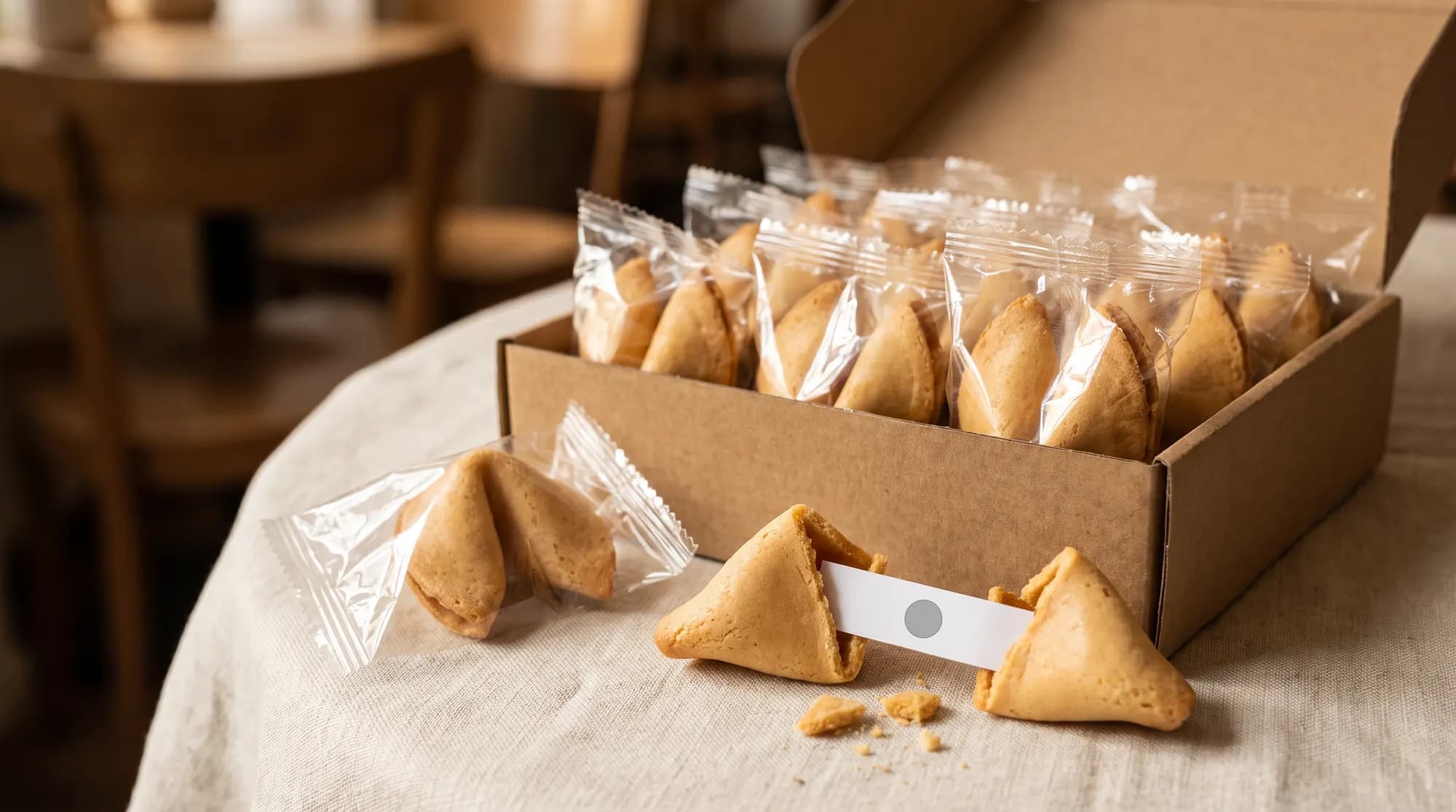
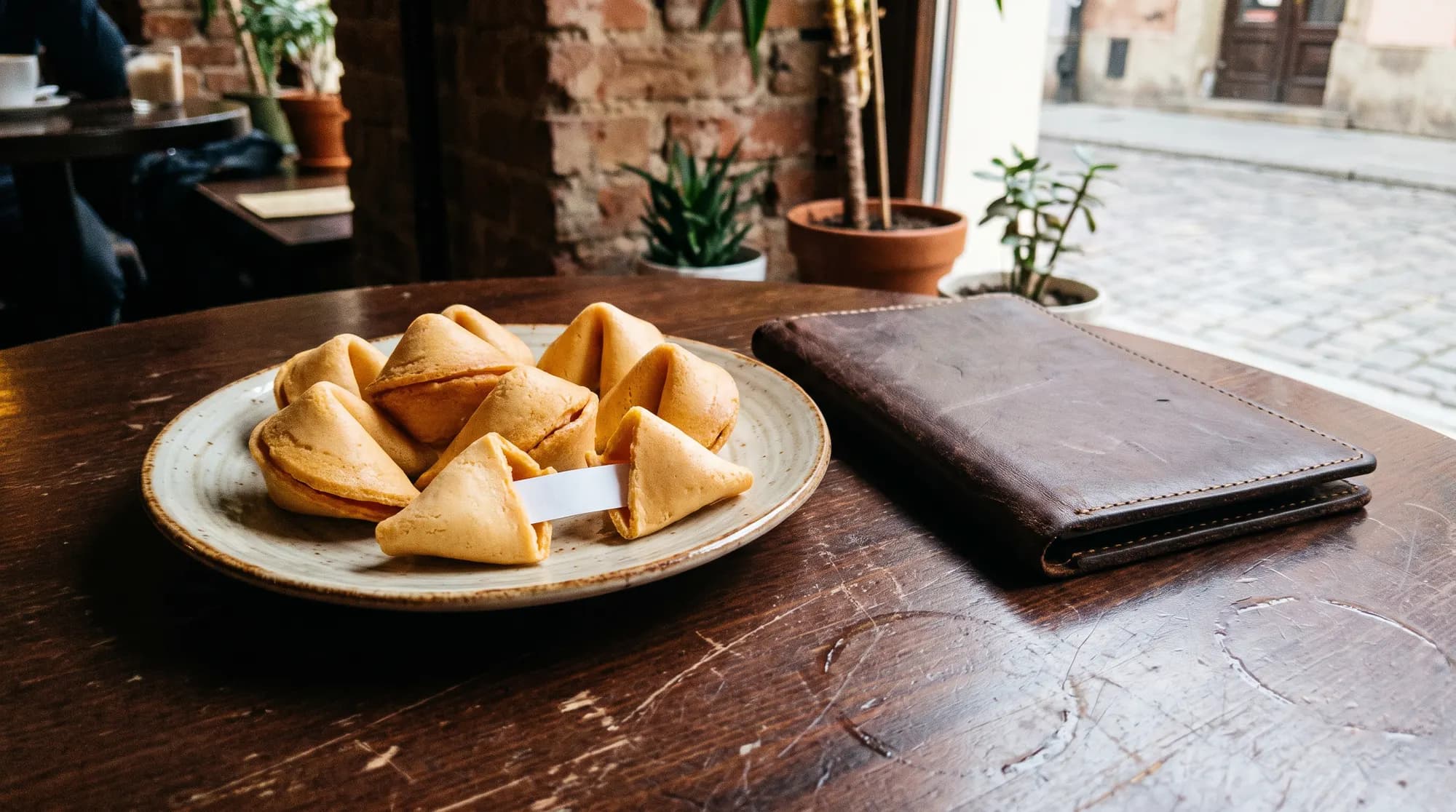
A fortune cookie is an almost textbook ambient format. Context: the end of a good meal, when the guest is relaxed and in no hurry. Surprise: inside there is a fortune people want to read, and under it an offer nobody expected to find there. Proximity: the slip is literally in the guest's hand, with no competing ad in sight.
Here is what a fortune for a local brand might look like. This is an illustrative example, not a real campaign:
This autumn you'll learn something that surprises everyone.
Scan to pick a time.
The two things that make it work are the choice of venue and the fortune itself. The fortune speaks to what matters to the guests of that particular place, and the offer suggests how to get there. That is how a Fortuners campaign works: we pick venues your customers already visit, write the fortune, produce and deliver the cookies, and count every QR scan. You can see the steps in How it works. For more on the format itself, read our article on custom fortune cookies as an ad campaign, and if you are curious where the tradition comes from, see the fortune cookie origin story.

Coasters, cup sleeves and takeaway bags
Working with a café or bakery lets you put your message on objects guests hold in their hands. A sleeve on a takeaway coffee travels with the customer to the office. An insert in a bread bag ends up on the kitchen table. The condition: the venue has to want the partnership, and the print must not clash with its image.
Placements inside a partner venue
A bathroom mirror, the entrance door, a counter display, the lunch-menu board. Ambient works best here when the message plays with the place. An illustrative concept: a climbing gym puts a small sticker on the stairs leading to a café's upper floor, with a line about your first climb. Every placement like this needs the owner's consent and should match the interior.
Ambient marketing ideas by industry
The ideas below are concepts for inspiration, not descriptions of campaigns that have run.
| Industry | Audience insight | Place | Ambient idea |
|---|---|---|---|
| Pilates studio | Matcha café guests tend to care about staying in shape | Matcha cafés within 20 minutes of the studio | A fortune about feeling strong, plus an invitation to a first class |
| Coworking space | Office workers rush their lunch and head back to a crowded open-plan office | Lunch bars near office buildings | A fortune about ideas that come outside the office, plus a trial week at the coworking space nearby |
| Arthouse cinema | Couples finish a good dinner and look for a plan for another evening | Restaurants popular for dinner for two | An offer for two tickets, served with the bill |
| Bike shop | Cyclists leave their bike outside a café and keep an eye on it through the window | Cafés along cycle routes | A tag on the rack outside the café inviting riders to a bike service, with the consent of the venue and the rack's manager |
| Cooking app | Guests admire a dish and wonder how to make it | Bistros with an open kitchen | A card by the plate with a code for a recipe for a similar dish |
How to plan an ambient campaign: from insight to execution
Good ambient starts with watching how people behave in a specific place, not with hunting for a spectacular format. Here is the process in seven steps.
1. A goal and one measurable action
Before you think about the format, decide what people should do after they come across the message. Book a trial class, download the app, redeem a discount in store. One action, one metric. Ambient without a goal ends with a nice portfolio photo and no lessons learned.
2. Insight: observation, not assumption
An insight is a true, often unspoken observation about what people do or need in a given place. A simple template helps:
When [the audience] is in [the place], they [what they do or feel], so [what they need or what crosses their mind].
A filled-in example: when an office worker eats lunch at a bar next to their building, they check the time and think about going back to a crowded open-plan office, so they are open to picturing a calmer desk a few hundred metres away. That insight leads straight to a message for a coworking space.
The best insights come from fieldwork. Spend an hour in the place where you want to run the campaign. Notice what people hold, what they wait for and when they have a moment away from their phone.
3. Map the places and moments
List the places your audience visits and the moment during the visit when they have attention to spare. Score each place on three things: how well its guests match your target group, how long the contact lasts and whether working with the owner is realistic. Keep the ones that score best.
4. The idea and the three-question test
Only now do you look for the format. Run every idea through the test of context, surprise and proximity. Add two control questions: is it clear within a few seconds who the message is from, and is it obvious what to do next?
5. Prototype and small test
Before you order thousands of units, test the idea in one or two places for a week. Watch whether people notice it, understand it and take the action. Ask the venue staff what guests have said.
6. Execution and logistics
This is where good ideas get ruined. Plan production with time to spare, deliveries to every location, restocking during the campaign, a short brief for the partner's staff and collection of materials at the end. Appoint one person who handles contact with the venues.
7. Documentation
Take photos and short videos of the execution. You will use them on the brand's social channels, in the report and when you talk to future partners. If you photograph guests, get their consent.
Permissions: property owners, public space and safety
Ambient happens in someone else's space, so permissions are part of the project, not an afterthought. The overview below is general and based on Polish rules; other countries have their own. It is not legal advice, and the details depend on the location and the format.
Private property and partner venues
In a café, restaurant, shopping centre or office building lobby, you need the consent of the owner or manager. Get it in writing, covering the location, the period, the type of placement, how it is installed and removed, and who is liable for any damage. Also agree who can change or end the campaign early.
Public space
In Poland, a pavement, a roadside verge or a bus bay is usually part of the road area. Placing an installation, stand or ad there requires a permit from the road authority to occupy that space, and a fee is normally charged. Applications take time, so build that into your timeline.
Municipalities can also adopt their own rules on advertising in public space, known as landscape resolutions (uchwały krajobrazowe), and their content and legal status change over time. Before running a campaign in a specific city, Warsaw included, check what currently applies with the city office.
Unauthorised stickers, posters or writing in places not meant for them can be a petty offence. Article 63a of the Polish Code of Petty Offences penalises putting up notices, posters or signs in a public place without the consent of whoever manages it. Listed heritage buildings also require approval from the heritage conservation officer.
Safety and accessibility
An installation must not block walkways, cover signage or obstruct an emergency exit, and any structural elements must be stable. Think about people using wheelchairs, parents with pushchairs and people with visual impairments. A stunt that draws a crowd may need extra arrangements.
Content and data
Some categories face specific advertising restrictions in Poland, including alcohol, tobacco and nicotine products, medicines and veterinary services. The message must not mislead. If the QR code leads to a form that collects personal data, you need a GDPR-compliant privacy notice, and a campaign with prizes should have written terms and conditions. If your ambient idea involves handing out food, use individual packaging with ingredient and allergen information.
How to measure ambient marketing
Ambient advertising has a reputation for being hard to measure. That is only true if you start thinking about measurement after launch. Plan it together with the format and you will get hard numbers.
| Method | What it shows | How to set it up | Limitations |
|---|---|---|---|
| Unique QR code | How many people responded, broken down by location | A separate code for each venue or placement type | A scan shows interest, not yet a customer |
| Discount code | How many purchases or sign-ups came from the campaign | One code per campaign or per venue, with an expiry date | Codes get shared beyond the target audience |
| Dedicated landing page URL | Traffic from placements without a QR code | A short address that is easy to type | Some people will type your main domain instead |
| "Where did you hear about us?" | What customers say | A form field or a question at sign-up | People's memory is unreliable |
| Mentions and photos | Buzz and content created by the audience | Monitoring brand tags and the campaign line | Hard to translate into sales |
| Comparison with a period or area without the campaign | Real uplift beyond what would have happened anyway | Sales data before, during and after, or a control district | Needs comparable data |
Illustrative example (all figures are made up for the calculation, not a price list): a campaign with a budget of PLN 10,000 reaches 2,000 people across six venues. 160 people scan the QR code and 40 redeem the discount code. That gives a scan rate of 8% (160 ÷ 2,000), scan-to-customer conversion of 25% (40 ÷ 160) and a customer acquisition cost of PLN 250 (PLN 10,000 ÷ 40). Compare that cost with what a customer is worth to your business, and keep the best-performing venues for the next round.
Track mentions separately, but do not ignore them. Good ambient sparks conversations at the table and photos on social media that keep working after the campaign ends. We cover how to encourage that kind of talk deliberately in our guide to word of mouth marketing offline. For a complete measurement system with a control group and a report template, see the guide to offline marketing attribution.
At Fortuners, every campaign gets its own QR link and discount code, and the brand follows scans, redeemed codes and each venue's results live in the partner panel, without waiting for a final report.
Ambient marketing checklist
Go through this list before you sign off the project. Any point without an answer is a risk you want to close before production.
Ambient marketing project: before launch
- The campaign goal and one measurable action are written down.
- The insight comes from observation on site, not from assumptions made at a desk.
- The chosen places match the target group and give people time to engage with the message.
- The idea passes the test of context, surprise and proximity.
- Within a few seconds it is clear who the message is from and what to do next.
- The idea has been tested on a small scale in one or two places.
- You have written consent from the owners or managers of every location.
- Road space permits and local advertising rules have been checked.
- The installation does not block walkways, emergency exits or accessibility.
- The content respects industry restrictions and does not mislead.
- Every location has its own QR or discount code, and the landing page works on a phone.
- The form has a GDPR privacy notice, and any prize campaign has terms and conditions.
- Deliveries, restocking, staff instructions and removal are arranged.
- You know who handles contact with venues and who owns the report.
- The date and format of the final report are agreed before launch.
If you want to see how ambient could work for your brand in restaurants and cafés, our guide to advertising in restaurants gives the wider picture of the channel. And once you have a goal and a target group, get in touch: we will pick the venues and suggest fortunes that fit your offer.
Frequently asked questions
What is ambient marketing?
Ambient marketing places a brand message inside the audience's surroundings: in an object, a place or a situation they are already in. Instead of another ad frame, people come across something that fits the moment, surprises them a little and is close at hand, often literally in their hand.
What is the difference between ambient marketing and guerrilla marketing?
Ambient is a way of placing a message in the environment, usually with the site owner's permission and for a set period. Guerrilla marketing is a wider low-budget approach built on surprise and buzz, often one-off and sometimes close to the legal line. Many campaigns combine the two, so the labels overlap.
Is ambient advertising only for big brands?
No. Big brands build installations in city centres, but a local business can work on a small scale: in cafés, restaurants, gyms or on a partner's packaging. What matters is the right context and a good fit with the audience, not the size of the installation.
How do you measure ambient marketing?
Build measurement into the placement itself: a unique QR code for each location, a discount code, a dedicated landing page and a question about where the customer heard of you. Add social mentions and photos, and compare results with a period or area without the campaign.
Do you need permission for ambient advertising in public space?
Usually, yes. On private property you need the consent of the owner or manager. In Poland, using part of a pavement or other road space requires a permit from the road authority, and local advertising rules and safety requirements also apply. Check the details with the city office or a lawyer.