Custom Fortune Cookies: From Promo Gift to Ad Campaign
Custom fortune cookies as an advertising medium: personalisation options, what to print on the slip, production, restaurant distribution and QR measurement.
8 min readFortuners Team
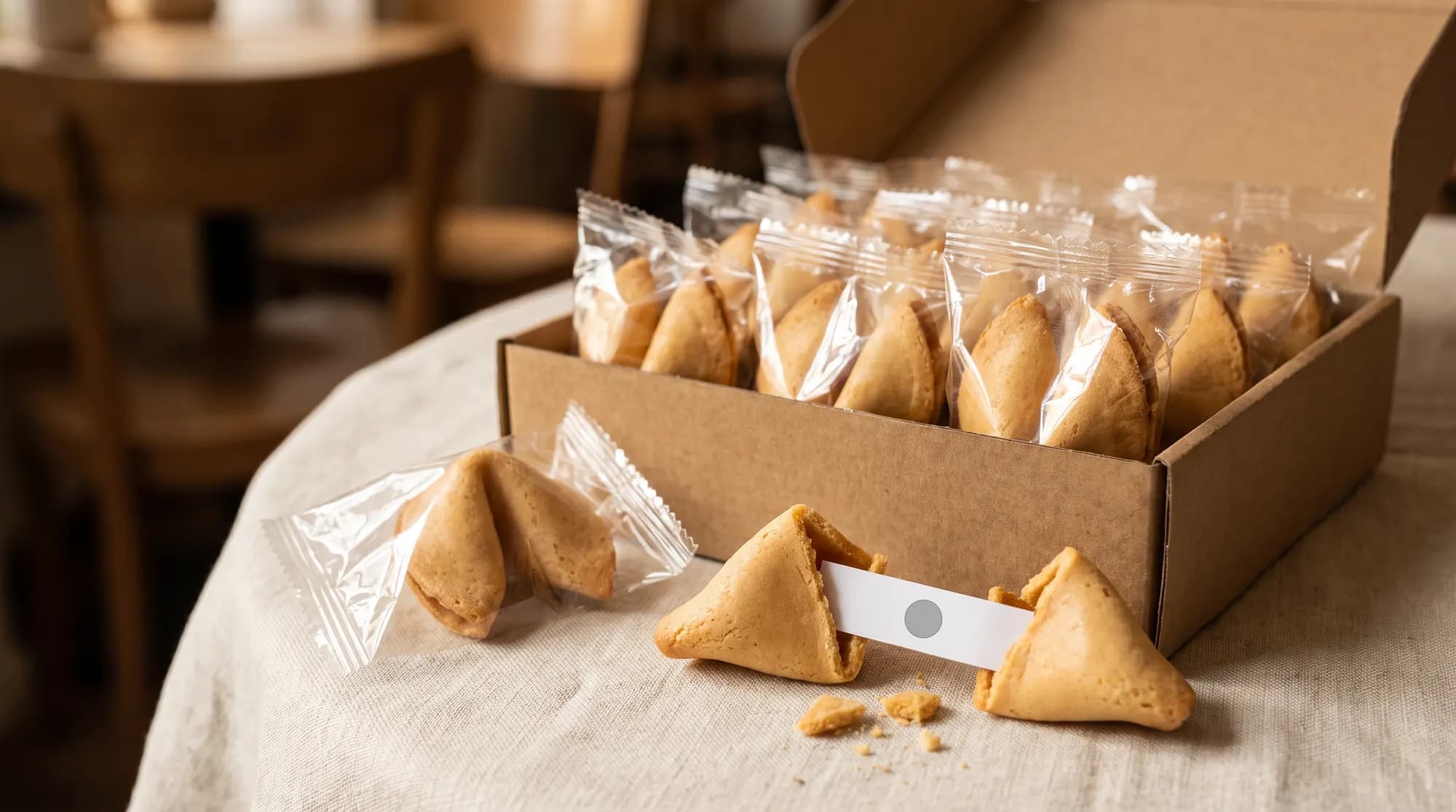
Custom fortune cookies come in three basic versions: a logo printed on the wrapper, a logo sticker on the wrapper, or your own message on the paper slip inside. Many orders combine a branded wrapper with a custom fortune. Before you choose, decide what the cookies are for. A promotional gift at an event should leave a good impression on people who already know you. An ad campaign in restaurants should bring in new customers, and you can measure it down to the last scan. This guide covers personalisation options, how to write a fortune with an offer and a QR code, production (including allergens), distribution channels, measurement and an order checklist.
Custom fortune cookie options: what you can personalise
Most producers let you combine several elements. Each one works at a different moment of contact with the recipient.
| Option | When people see it | When it makes sense | What to watch out for |
|---|---|---|---|
| Logo printed on the individual wrapper | Before opening | Events, reception desks, client gifts | Minimum order quantities and longer lead times, depending on the producer |
| Logo sticker on the wrapper | Before opening | Smaller runs, tight deadlines | Stickers applied by hand, placed straight |
| Custom fortune message on the slip | After opening | Any goal, especially campaigns | Message length and legibility at a small size |
| Logo or brand mark on the slip | After opening | Campaigns where the brand should be present but discreet | Fine logo details can disappear in small print |
| QR code or promo code on the slip | After opening | Campaigns with measurement | Size, contrast and a white margin around the code |
| Printed box or outer packaging | When handed over | Gift sets, client parcels | A separate design and a separate production schedule |
Some producers also offer coloured or chocolate-dipped cookies. That helps a gift stand out on a table, but it doesn't change what the recipient reads.
If the cookie is meant to be advertising rather than just a gift, the slip matters most. A wrapper with a big logo says "a company gave you something". A slip with a well-written fortune and an offer says "this is for you, take a look".
Promotional gift or ad campaign: two different goals
Search results for branded fortune cookies are dominated by promotional product shops, so it's easy to mix up these two uses. They differ in almost every way.
| Gift: event, office, client present | Campaign in restaurants | |
|---|---|---|
| Audience | People who already know you | New people, chosen by venue profile |
| Goal | Image, relationships, a nice gesture | Winning new customers |
| Slip content | Wishes, a slogan, a company in-joke | Fortune, logo, offer, QR code |
| Who chooses the place | You | You and the venue, which approves the brand |
| Logistics | One delivery to one address | Deliveries to many venues and regular restocking |
| Measurement | Usually none, or a survey | Scans and redeemed codes for each venue |
You can order a gift from an online shop. A campaign needs more: agreements with venues, matching those venues to your target group, a delivery plan and a landing page for the code. That's how a Fortuners campaign works: we pick restaurants and cafés in Warsaw, write the fortunes, produce and deliver the cookies, and the brand tracks scans and redeemed codes in its panel. Staff serve the cookie with the bill, so guests read it when they have a moment and their phone to hand.
A fortune cookie served in a restaurant is an example of advertising that surprises people in an everyday place. Read more about how formats like this work in our guide to ambient marketing.
What to print on the fortune: message, offer and QR code
A campaign slip has four parts, in this order:
- The fortune. Short, warm and linked to what matters to the reader. A guest at a matcha café may care about staying in shape, while an office worker at lunch is thinking about a moment to breathe.
- A discreet brand logo. Grey or single-colour, smaller than the fortune. The logo signs the message; it shouldn't shout over it.
- One offer. A specific benefit and a deadline, such as "Your first class is free until 31 October". No list of services and no price list.
- A QR code and a promo code. The QR code goes to a mobile-friendly page for that one offer, not to your home page. The promo code helps people who prefer to type it in later.
Your best idea this week will come to you away from your desk.
Code DESK26.
Sample fortunes for different brands (adapt them, and never promise what the brand can't deliver):
- bookshop: "Your next free evening belongs to a story you won't want to put down."
- bike shop: "Spring is about to surprise you on two wheels."
- language school: "Before long, you'll order your coffee in Polish without thinking twice."
- hair salon: "Tomorrow someone will ask who cuts your hair."
- theatre or cinema: "An evening is coming that you'll still be talking about at your next dinner out."
Rules that will save you rounds of corrections:
- No health or financial promises. A positive tone, yes. "You'll lose weight" or "you'll get rich", no.
- The offer has conditions people can check: an expiry date, one use per code, where it can be redeemed. For bigger promotions, prepare short terms and conditions.
- If the QR landing page collects data, such as a name and email address, you need a privacy notice that complies with the GDPR. Marketing consent must be separate and freely given. Confirm the details with a lawyer.
- Test the QR code on a print proof, on several phones and in dim light like you'd find in a restaurant.
If you're wondering where the idea of a message hidden in a cookie came from, read our piece on the fortune cookie origin.
Production: quantities, lead times, packaging and allergens
Order quantities. Producers have minimum orders and price breaks, and these vary by personalisation type: a sticker is often available for smaller runs than a printed wrapper. Ask for quotes on several quantities at once so you can see where the breaks are.
Lead times. Plan four stages: design and copy approval, printing the slips, baking and packing, and transport. Leave time for design changes and for checking a print proof. For a campaign across many venues, staggered deliveries work better than taking the whole run at once.
Packaging. For venues and events, choose individually wrapped cookies. That means better hygiene, a longer shelf life and space for product information. Store outer cartons somewhere dry, away from sunlight and moisture.
Allergens and labelling. Fortune cookies are prepacked food. If they are sold or handed out in Poland or elsewhere in the EU, the packaging must carry the information required by Regulation (EU) No 1169/2011 (opens in a new tab), including an ingredients list with allergens emphasised, a best-before date and the name and address of the responsible food business. The classic recipe is based on wheat flour, sugar and egg white, so the cookies usually contain gluten and egg. Legal responsibility for the label lies with the business under whose name the cookies are marketed (usually the producer, or the importer for cookies made outside the EU), but check it yourself before the cookies reach anyone. If you are an international brand ordering from a producer abroad for a campaign in Poland, make sure the mandatory information is also in Polish.
Distribution: events, offices and partner restaurants
Events and trade shows. A cookie on your stand is a conversation starter, and a slip with a QR code leads people to your materials after the event. Give each event its own code so you can compare them.
Offices, reception desks and client parcels. Custom cookies work well as an extra in online shop orders or as a welcome for visitors to your office. The slip can carry a code for the next purchase. The recipients already know you, so this is a retention tool rather than an acquisition one.
Partner restaurants. Here the cookie reaches new people, in a place chosen to match your target group. The venue has to approve the brand and the message (restaurants won't accept ads from competitors or from categories that clash with their guests), and someone has to keep every venue stocked. We cover this channel in more depth in our guide to advertising in restaurants.
How to measure the results of custom fortune cookies
Measurement starts at the design stage, not after the campaign.
- A unique QR code for each venue or event. The same page address with a different parameter (for example
?l=venue-3) shows which place generates scans. - A promo code for the campaign or for each venue. A scan shows interest; a redeemed code shows action.
- The number of cookies handed out. Without it you can't calculate any rate. In venues, count deliveries minus returns.
From this data you get three metrics:
| Metric | Formula | What it tells you |
|---|---|---|
| Scan rate | scans ÷ cookies handed out | Whether the fortune and the offer make people reach for their phone |
| Scan-to-redemption rate | redeemed codes ÷ scans | Whether the offer page and the offer itself are convincing |
| Cost per redemption | campaign cost ÷ redeemed codes | How much you pay for each person who took up the offer |
Illustrative example (made-up figures, not a benchmark): 2,000 cookies handed out, 140 scans and 35 redeemed codes give a scan rate of 7% and a scan-to-redemption rate of 25%. If one venue gets twice as many scans per cookie as the others, you move more stock there in the next round.
Cost per redemption isn't yet your cost per customer. Some people with the code would have bought anyway, and not everyone who used the offer will come back. So when you evaluate the campaign, add a column for how many code users made a second purchase, and compare sales with a period or with locations that had no campaign.
Common mistakes: one QR code for every place, a QR code that leads to the home page, an offer without an expiry date and a reusable code that quickly ends up on coupon sites.
Custom fortune cookie order checklist
Before you order custom fortune cookies
- Your goal in one sentence: brand image (gift) or new customers (campaign).
- Personalisation chosen: wrapper, sticker, slip or a combination.
- Fortune text (or several versions) approved, with no health or financial promises.
- One offer with an expiry date and clear terms.
- A QR code leading to a mobile-friendly offer page, separate for each venue or event.
- A print proof of the slip tested on several phones.
- Quotes for several quantities and a schedule with time for corrections.
- Individual wrappers with ingredients, allergens and a best-before date, in Polish for the Polish market.
- Confirmation that the slip paper and inks are suitable for food contact.
- A GDPR privacy notice on the landing page if you collect data, and promotion terms for bigger campaigns.
- A distribution plan: who restocks, where, how many cookies and when.
- A measurement sheet: cookies handed out, scans, redeemed codes and campaign cost.
If you want cookies carrying your offer to reach guests at selected restaurants in Warsaw, with results flowing into a panel instead of a manual tally, get in touch or email info@fortuners.pl.
Frequently asked questions
How much do custom fortune cookies cost?
The price depends on the quantity, the type of personalisation (printed wrapper, sticker, custom fortune), the packaging and the lead time. Producers usually have price breaks by quantity, so ask several of them to quote the same specification. A restaurant campaign is priced differently, because it also covers choosing venues, deliveries and measurement.
Can I write my own fortune messages?
Yes. A custom message on the slip is the most basic form of personalisation. You can use one fortune for the whole run or prepare several versions. In an ad campaign, the slip also carries a discreet logo, one offer and a QR code below the fortune.
Can I put a QR code on a fortune cookie slip?
Yes, as long as the code is large enough, has strong contrast and a white margin around it. Point it to a mobile-friendly page for a single offer, give each venue or event its own code and test a print proof on several phones before you order the full run.
Are fortune cookies safe for people with allergies?
The classic recipe is based on wheat flour, sugar and egg white, so fortune cookies usually contain gluten and egg. Ingredients and allergens should be listed on each individual wrapper. Always check the specification from your producer.
What is the difference between promotional fortune cookies and a fortune cookie campaign?
Promotional cookies go to people who already know you (event guests, clients, employees) and are meant to leave a good impression. A campaign reaches new people in selected venues, includes an offer with a QR code and should bring in customers you can count.