Local Marketing Strategy: A Guide for Brands in Big Cities
A step-by-step local marketing strategy: pick the right districts and venues, mix online and offline channels, plan a budget and measure campaign results.
16 min readFortuners Team

A local marketing strategy reaches the people who live, work or spend time in one part of a city and turns them into customers who can realistically get to you. In a big city, setting a 10 km radius in an ad panel is not a strategy. What works starts with a customer map: where your audience is, at what time of day and in what situation. Only then do you choose channels, design a reason for the first visit, set a budget and decide how you will measure it. This guide walks through all six steps and ends with a launch checklist.
What local marketing is, and when it beats a national campaign
Local marketing is not a smaller version of a national campaign. It asks a different question. Instead of “how do we reach as many people as possible?”, it asks “how do we reach the people who can walk in, drive over or book us this month?”. Every contact with someone outside that area is, in practice, spend you will never recover.
Three levels are worth separating when you plan:
| Hyperlocal marketing | Local marketing | National campaign | |
|---|---|---|---|
| Area | a street, an estate, a cluster of offices (a few hundred metres) | several districts or a city (15–20 minutes away) | the whole country |
| Typical advertiser | café, coworking space, salon | fitness studio, language school, cinema, clinic, small chain | e-commerce, product brand in retail chains |
| Main question | who walks past and works nearby? | where do customers realistically travel from? | how do we build awareness at scale? |
| Measurement | codes and a question at the counter | codes per channel and per venue, district comparisons | research, attribution models, sales data |
Local marketing wins when:
- the service requires a visit (classes, treatments, screenings, a desk in a coworking space, a repair shop),
- distance drives the decision, because nobody commutes an hour twice a week for a class,
- you are opening in a new district or city and need your first customers faster than a listing alone will bring them,
- a national brand is testing an offer and wants to check the message at a smaller, controlled scale.
If you sell only by post across the country, local marketing can be a test or an add-on, but rarely your main strategy. Campaign ideas for specific industries are collected in our marketing campaign examples for local brands.
Step 1: Map your customer by travel time, not kilometres
Most guides open with a list of channels. This one opens with a map, because the map decides which channels make sense. You can build it in four steps.
Draw the area in minutes, not on a ruler
A 3 km radius looks neat on screen, but it says nothing about how long it takes a customer to reach you. In Warsaw, two points on opposite banks of the Vistula can be close in a straight line and far apart in practice when there is no convenient bridge between them. Railway lines, ring roads and large parks do the same thing in every big city.
How to do it:
- Mark your location and check travel times from several directions — on foot, by bike, by public transport and by car — at the hours your customers actually travel.
- Use 15 to 20 minutes as the boundary for services people use regularly. For one-off visits, such as a screening or a consultation, you can stretch it.
- For a more precise picture, use isochrone maps (openrouteservice, for example), which draw the area reachable within a given time.
Take the example from our how it works section: a pilates studio in Praga sets its range at 20 minutes by bike or tram. It picks campaign venues inside that area — in Praga, Powiśle, Śródmieście and Saska Kępa — not across all of Warsaw.
Add workplaces and commuting routes
Your customer does not spend the whole day where they live. Someone living in Białołęka may work in Wola, and that is where they make buying decisions during a lunch break. So add to the map:
- office clusters within your range (in Warsaw, Wola, Służewiec or the area around Rondo ONZ),
- transport interchanges your customers pass through,
- places tied to daily rituals: cafés, breakfast bars, gyms, schools and nurseries.
If you are working in Warsaw specifically, our guide to advertising in Warsaw by district describes the character of individual districts and the way the city’s rhythm changes through the year.
Assign times of day and situations
The same person in the morning and in the evening is two different audiences. In the morning they are rushing to work; at lunch they have a quarter of an hour and a phone in hand; over dinner they are relaxed and open to plans for the weekend.
| Time of day | Where your customer is | State of mind | Message with a chance |
|---|---|---|---|
| Morning (7–10) | commute, coffee to go, breakfast bar | in a hurry | short, one benefit, easy to remember |
| Lunch (12–3) | lunch bars near offices, canteens, cafés | on a break, phone in hand | an offer to check right away, sign-up in a minute |
| After work (5–7) | shopping, the gym, the way home | tired, on autopilot | convenience, proximity, “on your way” |
| Evening and weekend | restaurants, cinema, meeting friends | relaxed, planning | days out, new experiences, plans for the week ahead |
Put the map in one table
You do not need a special tool. A spreadsheet with these columns is enough:
| Area | Who is there | When | Specific venues | What could prompt a first visit | Priority |
|---|---|---|---|---|---|
| Powiśle | office workers, students | lunch, evening | 3 cafés, 1 breakfast bar | a trial class after work | high |
| Saska Kępa | residents, families | weekend mornings | breakfast bars | Saturday classes | medium |
You probably already hold most of the data: postcodes from bookings, delivery addresses, answers to “which district do you travel from?” asked at sign-up, locations in reviews and your Google Business Profile insights. Collect it in aggregate form (district, not street address) and only to the extent you actually need.
If your business is hyperlocal — a café or a coworking space — build the same table at a scale of a few hundred metres: streets, office buildings and stops instead of districts, and specific footfall hours instead of broad parts of the day. Hyperlocal marketing needs a smaller budget but far closer observation of the streets around you.
Step 2: Get the online foundations right before you spend
Every offline channel ends up on a phone screen. Someone sees your poster, your flyer or your cookie, then checks you in maps, skims your reviews and opens your site. If something there does not add up, you have paid for a contact that will never become a visit. English-language searches for local marketing are dominated by advice about this layer, and for good reason: it is the cheapest part of the plan and the easiest to get wrong.
Before the campaign starts, make sure that:
- your Google Business Profile is complete: the right categories, current opening hours, photos of the interior and the entrance, and directions. This is usually the first contact someone searching nearby has with you.
- reviews are handled as a routine, not a panic. Ask every satisfied customer at the moment they are happiest, and reply to what comes in, the critical reviews included. Our guide to using a QR code for Google reviews covers a way of asking that does not annoy anyone.
- your details are identical everywhere: name, address and hours on your site, your profile, social media and any directory. Contradictions cost you visits and search visibility alike.
- your page answers the local question: where you are, how to get there, what the first visit looks like and what it costs in time. A landing page for the offer, visible without scrolling on a phone, beats a general home page.
- signing up takes a minute and does not require creating an account.
- geo-targeted ads cover the area from your map, not a default radius around a pin.
These basics are not a campaign. They are the floor the campaign stands on.
Step 3: Choose channels that reach the map
Once you have the map, channels stop being a wish list. You pick the ones that reach your highest-priority areas and situations. The table below compares the usual options descriptively, without prices, because those depend on the city, the scale and the supplier.
| Channel | Local reach | Barrier to entry | Measurability | Lead time (roughly) |
|---|---|---|---|---|
| Google Business Profile | people searching nearby | low: mostly time | medium: profile insights | a few days |
| Geo-targeted ads (search, social) | a chosen radius or list of locations | low, flexible budget | high for clicks, weaker for visits | a few days |
| Local groups and neighbourhood portals | active residents | low, but group rules apply | low to medium | a few days |
| Flyers and door drops | letterboxes, the street, pick-up points | medium: print and distribution | low without codes, medium with them | 1–2 weeks |
| Posters and outdoor | everyone passing a given spot | medium to high | low | 2–4 weeks |
| Local events and sponsorship | the event’s community | varies | medium: sign-ups, codes | from a few weeks |
| Partnerships with neighbouring businesses | the partner’s customers | low: mostly time | high with a separate code | 1–2 weeks |
| Restaurants and cafés (table materials, sampling, fortune cookies) | guests of selected venues | medium | high with a code per venue | 2–4 weeks |
A detailed comparison of twelve channels, with a ready-made first-quarter mix, is in our article on local business advertising channels.
Offline: contact in a place where the customer actually is
Offline channels give you what online lacks: physical presence at a specific place and time. Their weakness is measurement. A flyer without a code, a poster without a tagged URL and a sponsorship without a sign-up list produce an effect you cannot tell apart from luck. That is why every offline channel in this guide gets its own identifier — more on that in the measurement step.
Partner venues: choose the place and you choose the audience
Restaurants, cafés and bars are ready-made audience filters. District, type of food, price level and time of day say a great deal about who is sitting at the table. A matcha café draws different people than a burger bar by a stadium, and an office lunch bar different people than a restaurant built for dinner for two.
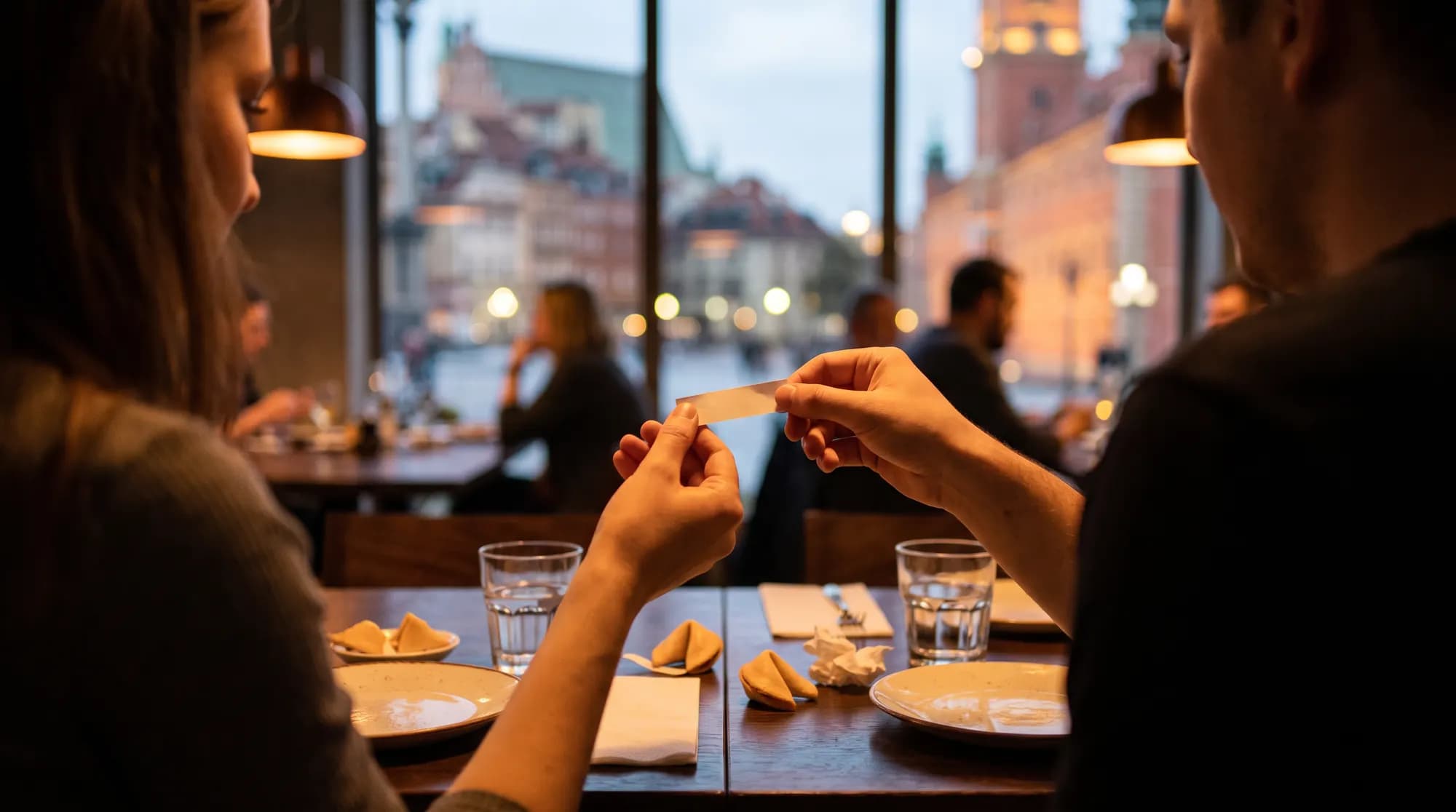
Ways to be present in a venue include table materials, sampling, joint events and a small gift handed to guests. That last format is what Fortuners is built on: a brand does not buy general “reach in the city” but fortune cookies served with the bill in selected restaurants and cafés. The slip carries the brand’s offer and a QR code, and every venue has its own identifier, so you can see which places produced scans and redeemed codes.
Word of mouth as an amplifier
Local channels work harder when people have a reason to talk about you: an unusual moment of contact, a gesture that surprises, a referral scheme. How to design that legally and measurably is covered in our guide to word of mouth marketing offline.
Step 4: Design a reason for the first visit
The biggest barrier in local services is the first visit. The customer does not know what your place is like, whether getting there is easy or whether it is worth the trip. “Come and visit us” removes none of those doubts. A good local offer has five features:
- One specific action: a trial class, a consultation, a trial week, a check-up.
- A low barrier: no commitment, no long form.
- Local context: something that says it is close, such as “12 minutes by tram from this café”.
- An expiry date: a date that prompts a decision within weeks, not “sometime”.
- Traceability: a code or a booking that lets you count who used it.
| Industry | First-visit offer (example) | What you measure |
|---|---|---|
| Pilates studio | first class free | bookings, attendance, passes bought |
| Coworking space | a trial week at a desk in the open space | trials taken up, contracts signed |
| Arthouse cinema | two tickets for the price of one on weekdays | codes redeemed at the box office |
| Language school | trial lesson and a level test | tests taken, course sign-ups |
| Bike shop with a workshop | a pre-season service check at a discount | workshop visits, purchases |
The first three come from the campaign examples on the Fortuners home page; the other two are illustrations for different industries.
Here is how a fortune slip carrying a language school’s offer might look, served to guests in a café near a university and an office cluster:
Before this year is out, you’ll hold a whole conversation in a new language.
If your offer is a price reduction, check the rules on price indication that apply to you. In Poland and across the EU, announcing a discount generally means showing the lowest price from the 30 days before the reduction. Confirm the details for your case with a lawyer.
Step 5: Budget and timeline (illustrative example)
The easiest way to size a local budget is backwards: from how many customers you need and how much you can pay to win one. That makes every channel easy to judge afterwards.
Illustrative example (made-up figures; not a rate card for any channel, Fortuners included):
- A new studio client stays about 5 months and the monthly margin per client is PLN 150. Customer value: 5 × PLN 150 = PLN 750.
- The studio decides it can spend at most a third of that value to win a client: PLN 250.
- The quarterly goal is 40 new clients. Maximum budget: 40 × PLN 250 = PLN 10,000.
- That budget is split by the customer map:
| Item | Amount (example) | Role |
|---|---|---|
| Online basics (photos, offer page, profile) | PLN 1,500 | the floor under every other channel |
| Geo-targeted ads | PLN 2,500 | reminders inside the mapped area |
| Offline channel in partner venues | PLN 4,500 | first contact in the highest-priority places |
| Materials, codes, reserve for testing | PLN 1,500 | print, fixes, extra weight behind the best channel |
| Total | PLN 10,000 |
After the campaign you check how many customers each channel brought and calculate the cost per customer separately for each one. If one channel comes out at PLN 180 per customer and another at PLN 600, you move the budget next quarter.
A four-week local campaign can run to this timeline:
| Week | What happens |
|---|---|
| −4 and −3 | customer map, brief, choice of areas and venues, first-visit offer |
| −2 | offer page, QR codes and promo codes per channel, artwork for print |
| −1 | codes tested on several phones, briefing for whoever handles sign-ups, baseline measured |
| 1–4 | campaign live, weekly review, quick fixes to the page and the message |
| 5–6 | follow-up with everyone who signed up, analysis, decision on the next quarter |
Step 6: Measure with QR codes, promo codes and a control group
Offline advertising has a reputation for being unmeasurable mostly because every channel points at the same home page. One rule fixes most of it: one channel and one venue equals one identifier.
A unique QR code per channel and per venue
Every piece of material gets its own QR code pointing at the offer page with UTM parameters. A poster in a café in Powiśle might lead to a URL carrying utm_source=cafe-powisle, utm_medium=offline and utm_campaign=autumn-2026. In your analytics you then see visits from each place separately. Dynamic codes let you change the destination without reprinting anything. How to build those links properly is covered in our QR code marketing guide.
A promo code where the customer never opens the page
If people walk straight into your premises, a QR code is not enough. A promo code tied to the channel or venue — a different one for each café — closes that gap. Staff enter it in the till system or note it in a sheet. That connects a channel not just to a scan but to an actual visit.
A source question and a control group
Identifiers never catch everything: someone sees a poster and then signs up because a friend recommended you. So:
- add a short “how did you hear about us?” question at sign-up, with a few fixed answers,
- measure a baseline: sign-ups in the four weeks before the campaign,
- if you operate in several similar districts, leave one without a campaign and compare. That is a simple geo test.
The full metric system, attribution models and a report template are in our guide to offline marketing attribution.
| Stage | Metric | Where the data comes from |
|---|---|---|
| Contact | materials handed out, impressions | channel supplier, your own count |
| Response | scans, clicks | QR code, UTM tags, site analytics |
| Enquiry | sign-ups, forms, bookings | booking system, CRM |
| Visit | codes redeemed, attendance | till system, attendance list |
| Customer | pass bought, contract signed | sales system |
Keep this table separately for each channel and venue. A plain spreadsheet updated once a week is enough.
GDPR when the post-scan form collects data
When the page behind the code collects a name, an email address or a phone number, you are processing personal data. In practice that mainly means:
- saying who the data controller is, why and on what basis you process the data, and how long you keep it,
- collecting only what you need to deliver the offer,
- a separate, unticked consent box if you want to send offers by email or text later,
- a data processing agreement with the form tool provider if they store the data.
These are general pointers, not legal advice. Have a lawyer or a data protection officer review your privacy notice and consent wording.
Common local marketing mistakes
- Drawing the area in kilometres instead of minutes. The campaign reaches people who are technically close but will never cross the river for a class.
- Every channel at once, none of them properly. After a month you cannot tell what worked, because no channel had enough contacts to judge.
- No first-visit offer. A logo and a slogan build recognition but give nobody a reason to come this month.
- One code for everything. A single promo code shared by flyers, posters and venues tells you only that “something worked”.
- A landing page that does not match the message. A code from a trial-week offer lands on a home page full of membership tiers.
- Nobody owning the replies. A sign-up with no answer within a day is, in practice, a wasted contact.
- Judging it after a week. Where the decision takes thought, the first few days show nothing. Judge after the whole campaign and after the period customers had to use the offer.
- Materials put up without permission. Posters on fences and lamp posts without the owner’s or manager’s consent can end in a fine. Check local rules on advertising in public space too — in Poland, many cities have adopted a landscape resolution (uchwała krajobrazowa) that governs signage and outdoor advertising.
- A message copied from the national campaign. People respond to “five minutes from your office”, not to a line that could hang in any city in the country.
Local campaign launch checklist
Before you launch
- Customer map: the 15–20 minute area, office clusters, routes and times of day, written down in one table
- Two or three priority areas chosen, with specific venues named in each
- The goal in numbers: how many new customers and the maximum you will pay for one
- A first-visit offer with one action, local context and an expiry date
- Google Business Profile and the offer page checked on a phone
- A separate QR code with UTM parameters and a separate promo code for every channel and venue
- A sign-up form with a privacy notice and a separate marketing consent box
- Permission from venue owners, and local advertising rules checked
- A baseline: sign-ups or customers in the four weeks before launch
- Someone responsible for answering enquiries within a day
- A weekly review slot in the calendar and a date for the final analysis
- A plan for moving budget to the best channel after the first quarter
Local marketing in a big city works best when every decision comes back to the customer map: where they are, when, and in what situation. If restaurants and cafés end up among your highest-priority places, get in touch and we will help you pick venues in the districts you care about.
Frequently asked questions
What is the difference between local and hyperlocal marketing?
Local marketing covers a city, a few districts or the area a customer can reach in 15 to 20 minutes. Hyperlocal marketing narrows that down to a few hundred metres: one street, one housing estate or one cluster of office buildings. Businesses people walk to, such as a coworking space, a café or a salon, usually work hyperlocally.
How do I start a local marketing strategy on a small budget?
Start with a customer map and the basics that cost mostly time: a complete Google Business Profile, reviews and a page that shows your offer and how to get to you. Then pick one offline channel in the area where most of your customers already spend time and give it its own QR code or promo code. Measuring one channel properly beats spreading a small budget across five.
How do you measure offline local marketing?
Give every channel and every venue its own identifier: a separate QR code with UTM parameters, a separate promo code or a dedicated landing page. Add a short “how did you hear about us?” question at sign-up, and compare results with the weeks before the campaign or with a similar district where you ran nothing.
Does local marketing make sense for a national brand?
Yes, when the brand opens a location in a new city, tests an offer before a wider launch, or sells a service available only in selected places. Running in a few districts lets you test the message and the offer at a controlled scale before national money goes behind them.