Real Estate Developer Marketing: A Local Sales Campaign
Real estate developer marketing at neighbourhood level: reach people who live or work near the project, bring them to the sales office, meet disclosure rules.
8 min readFortuners Team
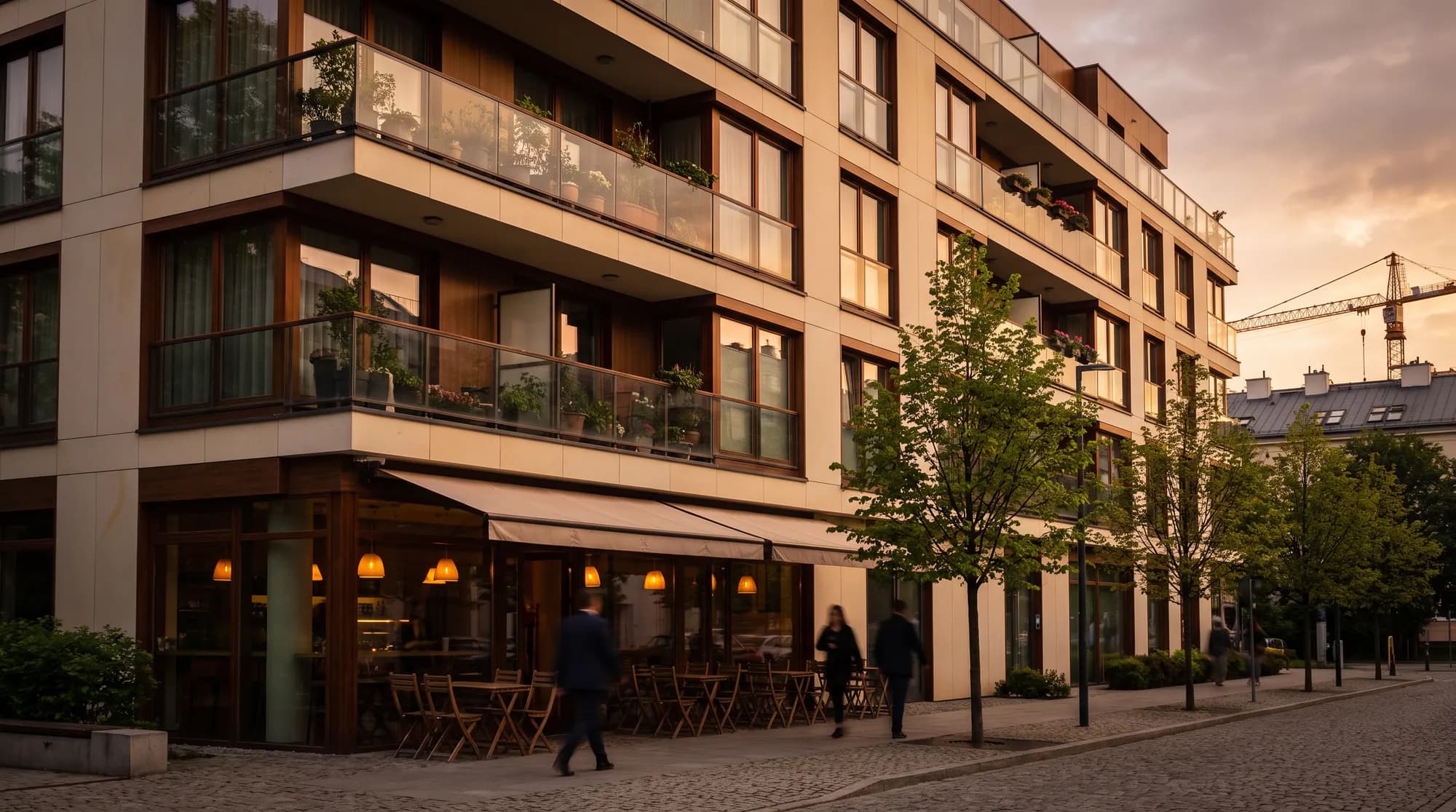
Real estate developer marketing covers everything a developer does to sell the homes in a specific project at a pace that matches the construction schedule. Most buyers choose a home by location first, so one of the most natural audiences is people who already know the area: they live a few streets away, work nearby, have parents in the neighbourhood or children at a local school. This guide shows how to reach them locally, what offer to put in front of them, how to turn a first contact into a visit to your sales office, and which disclosure rules apply in Poland, including the price transparency requirements in force since 2025.
Who buys a home in your development
Before you choose channels, describe who can realistically buy in this particular project. Floor plans, unit sizes and the surroundings tell you more than a generic persona like "family, 30+".
| Segment | Motivation | Typical concerns | What to show |
|---|---|---|---|
| Local residents who need more space | staying in the area: school, parents, work | selling their current home, timing the move | construction schedule, three- and four-room layouts, walking routes to schools and nurseries |
| First-time buyers, often renters from the area | owning instead of renting | mortgage, deposit, total price | smaller units, total price including a parking space, a conversation with a mortgage adviser |
| Investors | rental income or a place to park capital | rental demand, running costs | proximity to universities, office hubs and public transport, efficient layouts |
| Parents buying for adult children | a secure start for their child | location, safety, commute | travel time to universities or the city centre, the neighbourhood |
| Downsizers | a lift, no stairs, services nearby | leaving a familiar area, paperwork | ground and lower floors, shops, clinics and green space nearby |
| International professionals working nearby | a shorter commute, settling in Poland long term | contracts in Polish, unfamiliar procedures, whether they need a permit | materials and consultations in English, a clear step-by-step buying process |
Your best source of insight is your own data. Check the CRM from previous projects: which districts buyers came from, how old they were, whether they bought to live in or to let. If that data is missing, add two questions to the sign-up form and to sales office conversations: "Where do you live now?" and "Who are you looking for a home for?"
Sales stages of a development and the marketing goal at each
A single campaign for the whole project rarely works, because buyers ask different questions at each stage of construction. In Poland, homes in new developments are commonly sold off-plan, so the sequence below usually starts long before anyone can walk through a finished apartment.
| Stage | Marketing goal | Local activities | Main metric |
|---|---|---|---|
| Before sales launch | a waiting list of interested people from the area | landing page with a waiting-list sign-up, information on the site hoarding, a meeting for neighbours | waiting-list sign-ups |
| Sales launch | first reservation agreements | invitations to the waiting list, an open day at the sales office, a campaign in venues nearby | booked and attended visits |
| Construction | keeping the pace, selling less obvious units | neighbourhood walks, construction progress updates, offers for specific segments | reservations per month |
| Show apartment and handovers | converting people who want to see a finished interior | show apartment visits, weekend open days | visits ending in a reservation |
| Final sales | last apartments, commercial units, parking spaces | communication to residents of neighbouring buildings and local businesses | remaining units sold |
Ground-floor commercial units deserve their own plan. A café, bakery or clinic downstairs makes the whole development more attractive, and you find future tenants or buyers for those units locally too, among businesses already operating in the district.
Marketing around the development: where to meet future residents
Start with a map. Mark an area within 10 to 20 minutes on foot, by bike or by tram from the site, and plot the places where people from that area spend their time. We explain how to build this kind of customer map in more detail in our local marketing strategy guide.
| Place or channel | Who you meet there | How to measure |
|---|---|---|
| Neighbourhood cafés and bakeries | residents on weekend mornings, parents after the school run | a separate QR code for each venue |
| Lunch bars near office buildings | people who work in the district | a code per venue, a form question about where they work |
| Sports clubs, swimming pools, dance schools | active residents, families | a code on the material, the facility owner's consent |
| District events and fairs | local families | sign-ups at the stand, an event-specific code |
| Site hoarding and sales office | passers-by and neighbours | a short web address, a code on the banner |
| Local news sites and residents' groups | people who follow what happens in the district | links with UTM parameters |
| Location-targeted online ads | residents and people who spend time in the area | UTM parameters, form sign-ups |
For boards and banners on the site hoarding, check local rules on outdoor advertising. Some municipalities have a landscape resolution (uchwała krajobrazowa) that sets out where and in what form boards and banners may appear. Warsaw is preparing a new one (opens in a new tab) (in Polish), because its January 2020 resolution was struck down by the Mazovian voivode in a supervisory decision, so check the current status with the city or district office before the campaign.
Cafés and restaurants: a moment at the table, not a scrolling feed
A café two streets from the site is a place where a future resident has time and attention, and is already in the neighbourhood you want them to picture themselves in. In the Fortuners model, guests receive a fortune cookie with their bill. The slip inside carries a fortune, the development's offer and a QR code assigned to that specific venue. The brand chooses venues near the project and sees scans and redeemed codes for each location in its dashboard. For how to match venues to the guest profile you need, see our guide to advertising in restaurants.
An illustrative example for a development in Warsaw's Bielany district:
Soon you will open a new door, and not far from here.
In a real campaign, the slip and the page after the scan would also include the address of the website with apartment prices. The section on disclosure rules explains why.
Variants for different segments, to develop further:
| Segment and venue | Example fortune | Example offer |
|---|---|---|
| Parents at a café near a school | "Soon everyone at home will have a corner of their own." | a Saturday walk around the development, including the route to school |
| Renters at a breakfast bar | "Soon you will hang a picture without asking anyone's permission." | a consultation with a mortgage adviser at the sales office |
| Office workers at lunch | "Your commute could be shorter than this lunch break." | a show apartment visit after work |
| International professionals near an office hub | "A new chapter is closer than you think, maybe just a few tram stops away." | a sales office consultation in English |
Before the campaign goes live, every venue approves the brand and the message, and the fortune should never promise anything the offer does not deliver. For venues with many international guests, write the slip in English or in both languages. You will find playbooks for other industries in our marketing campaign examples for local brands, and sample venue campaigns in the campaign examples on our home page.
An offer worth scanning: open day, show apartment, consultation
Nobody buys an apartment after scanning a code over coffee. A good offer leads to the next step, and that step has to be doable on the spot on a phone: pick a time slot, sign up, get directions.
| Offer | Who it is for | What has to work after the scan | Risk |
|---|---|---|---|
| Show apartment visit | everyone, especially people who want to see a finished interior | a calendar with available slots, confirmation, a map | no-shows if there is no reminder |
| Open day or neighbourhood walk | families, local residents | booking a time slot, the programme of the visit | weather and groups that are too large |
| Mortgage adviser consultation | first-time buyers | choosing a slot, a list of documents to bring | mortgage credit intermediaries must be entered in the register kept by the Polish Financial Supervision Authority (KNF) |
| Downloadable unit card and floor plan | people at an early stage | choosing a unit type, signing up for contact | a form that is too long |
Keep the page after the scan short: one sentence about the development, a photo or a visualisation labelled as illustrative, the distance from the venue where the guest scanned the code, a booking calendar, a form with as few fields as possible and a link to the price page. Do not hide the price list behind a form. Prices have to be public anyway, and hiding them puts off people who want to check first whether a home is within their budget.
Disclosure rules and price transparency in Poland
A developer advertises a product that involves one of the biggest financial decisions of a consumer's life. The rules in Poland are more detailed here than in most industries.
Price transparency. Since 11 July 2025, amendments to the Act on the Protection of the Rights of Buyers of Residential Premises or Single-Family Houses and on the Developer Guarantee Fund, widely known as the price transparency act, have been in force, with a short transitional period for projects already on sale. Put simply, a developer must run a website showing the prices of the apartments and houses on offer (per square metre and in total, including prices of ancillary units such as storage rooms and parking spaces, other charges payable to the developer, and the history of price changes), send that data once a day to the minister responsible for digital affairs, who publishes it on the government open data portal dane.gov.pl, and include the website's address in advertisements, announcements and sales offers aimed at buyers. The obligations are set out in Articles 19a and 19b of the act's current consolidated text (opens in a new tab) (in Polish). For an English summary, see this overview by the law firm Traple Konarski Podrecki and Partners (opens in a new tab). In campaign practice, the safest approach is to put the price page address on every piece of material, even something as small as a fortune slip, and on the page after the scan.
Information prospectus. Before a reservation agreement or a development agreement is signed, the buyer must receive an information prospectus. Your campaign must not promise anything that contradicts it.
Honest advertising. Poland's Act on Counteracting Unfair Market Practices prohibits misleading consumers, including by leaving out material information. In developer advertising, this most often concerns:
- visualisations: greenery, views and surroundings that will not exist,
- distances and travel times: check "5 minutes to the metro" in real conditions,
- floor areas: state them the same way as in the prospectus and the agreement,
- "from" prices: such a price must apply to units actually available,
- promotions: terms, deadlines and what the discount applies to must be clear and consistent with the prices published on the website.
GDPR and leads. A sign-up form for a visit collects personal data. You need a privacy notice, a clear purpose for processing, separate marketing consents that are not pre-ticked, and data retention rules. If you pass a contact on to a partner such as a mortgage adviser, the person has to know about it and you need a legal basis for doing so.
Measurement: from scan to reservation agreement
Weeks or months pass between first contact and a reservation agreement. If you only wait for signed agreements, you will find out whether the campaign worked when it is too late to fix anything. So measure the intermediate stages and record the source of every contact.
| Stage | Metric | Data source |
|---|---|---|
| Contact | materials handed out or ad impressions | delivery reports, ad platform |
| Interest | scans and website visits | QR code counter, web analytics |
| Sign-up | bookings for visits, open days and consultations | form, booking calendar |
| Visit | meetings that took place | CRM, sales office |
| Reservation | reservation agreements | CRM |
| Sale | development agreements | CRM, sales team |
In your CRM, every contact should have at least: date of first contact, channel, the specific venue or code, segment (to live in, investment, for family), status, visit date and reason for dropping out. Before launch, agree on an attribution window, for example a few months from first contact, and apply it to every channel.
Illustrative example (made-up figures, not a benchmark): a campaign in 8 cafés near the development. Guests receive 5,000 pieces of material with a code. 250 people scan the code, 40 book a visit, 26 turn up, and 3 reservation agreements are signed within the attribution window. The cost per reservation is the total campaign cost divided by 3. Compare it with the same metric for property portals and online ads, calculated by the same rules. We show how in our guide on how to calculate customer acquisition cost.
A funnel like this tells you straight away what to improve. Plenty of scans but few sign-ups point to a problem with the landing page or the offer. Plenty of sign-ups but few attended visits suggest missing reminders or inconvenient time slots. Visits without reservations are a topic for a conversation with the sales office about why people drop out.
If you want to check whether the venues around your development are a good fit for a campaign, get in touch. We will pick cafés and restaurants within a radius that makes sense for your buyers and show you how measurement will work.
Frequently asked questions
How do you reach people who live near a new development?
Draw an area within 10 to 20 minutes on foot, by bike or by tram from the project and map where those people spend their time: cafés, bakeries, lunch bars, sports clubs, local events and online neighbourhood groups. In those places, invite them to one specific next step, such as a show apartment visit, and give each place its own code so you know where buyers come from.
Do developers in Poland have to show apartment prices in their advertising?
Since 11 July 2025, developers in Poland must publish the prices of the apartments and houses they offer on their own website and include that website's address in every advertisement, announcement and sales offer. Any price that does appear in an ad must match the actual offer. Have a lawyer check the details of a specific campaign.
Can visualisations in property ads differ from reality?
A visualisation is illustrative by nature, but it must not mislead buyers about material features of the offer, such as the surroundings, views, greenery or distances. Label visualisations as illustrative and do not show elements that will not exist in the development or the neighbourhood.
How do you measure a developer's campaign when the buying decision takes months?
Measure the intermediate steps that happen quickly: scans, booked visits and visits that actually take place at the sales office. Log every contact in your CRM with its channel and exact source, and attribute reservation agreements to the campaign within an attribution window agreed in advance, for example a few months from first contact.